
🔴 Currently Active
LIVE DATA⛈️ Complete Storm Type Database
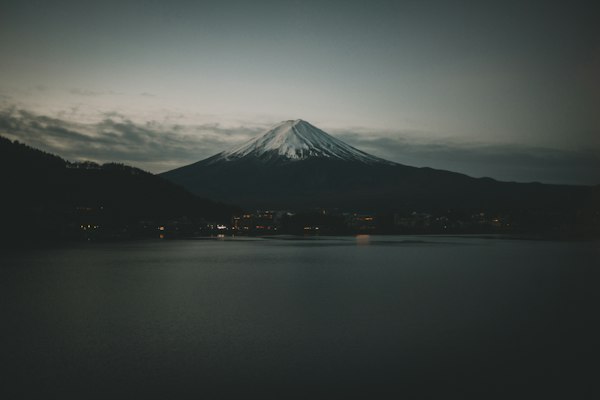
Hurricane
Atlantic & East PacificFormation Requirements
- Ocean temp >26.5°C to 50m depth
- Low wind shear (vertical)
- 5°+ from equator (Coriolis)
- Pre-existing disturbance
- High humidity mid-levels
Saffir-Simpson Scale
Energy Source
Latent heat from condensation powers the storm. Warm ocean evaporates water → rises → condenses → releases heat → strengthens updrafts → pulls in more air → positive feedback loop. Storm dies when it hits land or cold water.
| Storm | Year | Category | Record |
|---|---|---|---|
| Bhola Cyclone | 1970 | Cat 3 | Deadliest: 300,000-500,000 deaths (Bangladesh) |
| Patricia | 2015 | Cat 5 | Strongest: 345 km/h winds (Eastern Pacific) |
| Katrina | 2005 | Cat 5 | Costliest: $125 billion damage (US Gulf Coast) |
| Wilma | 2005 | Cat 5 | Lowest pressure: 882 mb (Atlantic record) |
| Allen | 1980 | Cat 5 | Longest Cat 5 duration: 72 hours |
| Mitch | 1998 | Cat 5 | 2nd deadliest Atlantic: 11,000+ deaths |
| Harvey | 2017 | Cat 4 | Wettest: 1,539mm rainfall (Texas) |
| Dorian | 2019 | Cat 5 | Strongest Atlantic landfall: 298 km/h (Bahamas) |
⚠️ 2005 Atlantic Season - Record Breaker
- 28 named storms (ran out of names, used Greek alphabet)
- 15 hurricanes (7 major)
- 4 Category 5 hurricanes (Dennis, Emily, Katrina, Rita, Wilma)
- Katrina, Rita, Wilma all in top 10 costliest ever
⚠️ Quick Records
- Deadliest: Bhola 1970 (500,000 deaths)
- Costliest: Katrina 2005 ($125B)
- Strongest: Patricia 2015 (345 km/h)

Typhoon
Northwest PacificSame as Hurricane, Different Name
Typhoons are the most frequent tropical cyclones globally. The warm Pacific pool provides ideal conditions. Japan, Philippines, Taiwan, China, Korea most affected.
Super Typhoons (Cat 4-5 equivalent)
- Haiyan 2013: 315 km/h (Philippines)
- Tip 1979: Largest ever (2,220 km diameter)
- Goni 2020: 315 km/h at landfall
Perfect Conditions Year-Round
- Warm Pool: Western Pacific warmest ocean area globally (28-30°C)
- No "off-season": Can form any month (unlike Atlantic)
- Vast fetch: Long ocean path to strengthen before landfall
- Monsoon trough: Constant supply of disturbances
- ITCZ: Intertropical Convergence Zone provides energy
Annual Statistics
| Name | Year | Peak Winds | Notable For |
|---|---|---|---|
| Tip | 1979 | 305 km/h | Largest diameter ever: 2,220 km |
| Haiyan | 2013 | 315 km/h | Strongest at landfall: 6,300 deaths (Philippines) |
| Goni | 2020 | 315 km/h | Tied strongest landfall (Philippines) |
| Meranti | 2016 | 315 km/h | Strongest of 2016 globally |
| Mangkhut | 2018 | 285 km/h | Largest since Tip: 2,000 km diameter |
| Vera | 1959 | 305 km/h | Deadliest Japan typhoon: 5,098 deaths |

Tropical Cyclone
Indian Ocean & South PacificRegions
- Bay of Bengal: Pre-monsoon (Apr-May) + Post-monsoon (Oct-Nov)
- Arabian Sea: Same seasons, less frequent
- South Pacific: Nov-Apr (Southern Hemisphere)
- Australia: Nov-Apr cyclone season
Bay of Bengal - Deadliest Region
Shallow bay + low-lying Bangladesh = catastrophic storm surge. 1970 Bhola cyclone killed 300,000-500,000. 1991 Bangladesh cyclone: 138,000.
Storm Surge Formation
Wind setup: Hurricane winds push water toward shore. Pressure effect: Low pressure center "lifts" sea surface (1 mb drop = 1 cm rise). Wave action: Waves on top of surge add height. Can reach 6-9 meters above normal tide.
Bangladesh Vulnerability
- 70% of land <6m above sea level
- Dense population in coastal areas (50M+ people)
- Funnel shape of Bay of Bengal concentrates surge
- Ganges-Brahmaputra delta = flat floodplains
- Cyclone shelters now save thousands vs. 1970/1991
- 1970 Bhola: 10m surge, 500,000 deaths
- 1991 Bangladesh: 6m surge, 138,000 deaths
- 2008 Nargis (Myanmar): 5m surge, 138,000 deaths
Northern Australia Season
- Season: November to April (Southern Hemisphere summer)
- Average: 11 cyclones per season
- Region: Queensland, Northern Territory, Western Australia coasts
- Category scale: 1-5 (similar to Saffir-Simpson)
Notable Australian Cyclones
| Tracy (1974) | Cat 4 - Destroyed Darwin on Christmas Day |
| Larry (2006) | Cat 5 - $1.5B damage (Queensland) |
| Yasi (2011) | Cat 5 - One of strongest at landfall |
| Debbie (2017) | Cat 4 - Severe flooding, $2B+ damage |

Tornado
Rotating column of airEnhanced Fujita Scale
Tornado Alley
Central US: Cold dry air from Canada meets warm moist air from Gulf of Mexico. Flat terrain allows storms to develop. Texas to Nebraska peak zone.
Required Ingredients
- Instability: Warm moist air at surface + cold dry air aloft
- Wind shear: Changing winds create rotation
- Trigger: Front, dryline, or convergence to start updraft
- Moisture: Dewpoints >15°C at surface
| Record | Event | Details |
|---|---|---|
| Deadliest Single | Tri-State 1925 | 695 deaths, 352 km path (MO-IL-IN) |
| Widest | El Reno 2013 | 4.2 km wide (Oklahoma) |
| Fastest Wind | Bridge Creek 1999 | 486 km/h measured (Oklahoma) |
| Longest Track | Tri-State 1925 | 352 km across 3 states |
| Deadliest Outbreak | April 2011 | 362 deaths, 360+ tornadoes in 3 days |
| Most in 24 Hours | April 27, 2011 | 216 tornadoes |
| Most Violent | Super Outbreak 1974 | 148 tornadoes, 30 F4/F5 rated |
| Costliest | Joplin 2011 | $2.8B damage, 158 deaths (EF5) |
Less than 1% of all tornadoes reach EF5 intensity. Last EF5: Moore, Oklahoma (May 20, 2013).
Annual Tornado Count by Country
🔥 Surprising Fact
UK has more tornadoes per land area than USA (but much weaker). Netherlands also extremely high density. Most are EF0-EF1.
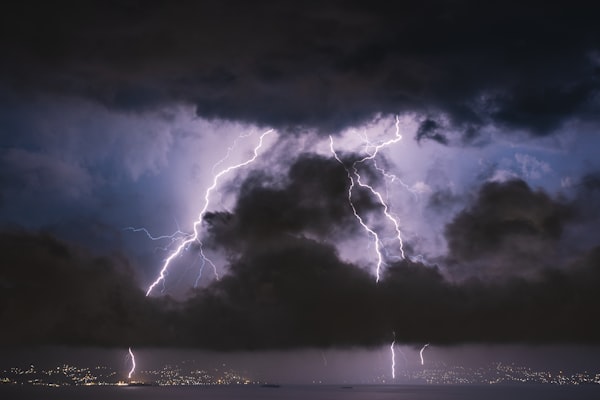
Thunderstorm
Cumulonimbus cloud systemsTypes
- Single-cell: Ordinary, 30-60 min, weak
- Multi-cell: Cluster, longer-lived, stronger
- Squall line: Linear, 100s of km, derechos
- Supercell: Rotating, severe weather, tornadoes
⚡ Lightning Facts
- Temperature: 30,000°C (5x sun surface)
- Speed: 300,000 km/h
- Global: 8 million strikes/day
- Deaths: ~2,000/year worldwide
Why Supercells Live Longer
Normal storms: Downdraft kills updraft. Supercells: Tilted updraft keeps rain/downdraft separate. Storm can last 2-6 hours, travel hundreds of km.
How Lightning Forms
- Ice particles collide in cloud, transferring charge
- Positive charge accumulates at top, negative at bottom
- Ground becomes positively charged by induction
- Stepped leader (invisible) descends from cloud
- Streamer rises from ground to meet it
- Connection made - massive current flows (visible flash)
- Multiple return strokes in <1 second
Types of Lightning
- Cloud-to-ground (CG): Most dangerous, 25% of all lightning
- Intra-cloud (IC): Within same cloud, 75% of lightning
- Cloud-to-cloud (CC): Between separate clouds
- Positive CG: From cloud top, 10% but most powerful
- Ball lightning: Rare, unexplained phenomena
⚡ Lightning Statistics

Supercell
Rotating thunderstormKey Feature: Mesocyclone
Rotating updraft distinguishes supercells. Can persist for hours. Most produce large hail; 25% produce tornadoes.
Structure
- Wall cloud: Lowered rotating base
- Anvil: Ice-crystal top spreads out
- Flanking line: Feeder clouds
- Rear-flank downdraft: Wraps tornado
Main Components
Visual Features Storm Chasers Look For
- Wall cloud: Lowered rotating base under main storm
- Tail cloud: Inflow band feeding into wall cloud
- Striations: Horizontal banding showing rotation
- Beaver tail: Smooth inflow band (HP supercells)
- Clear slot: RFD wrapping around, tornado imminent
- Mammatus: Pouch-like clouds on anvil underside
Three Main Types
- Minimal rain, excellent visibility
- Dry environment (high plains)
- Weak tornadoes but large hail common
- Storm chasers love these - easy to photograph
- Balanced precipitation
- Clear structure visible
- Most photogenic, distinct wall cloud
- Highest tornado probability (30-50%)
- Large hail + damaging winds
- Heavy rain wraps around mesocyclone
- Tornado often rain-wrapped (invisible)
- Most dangerous for storm chasers
- Flash flooding + large hail
- Common in humid environments (SE US)

Derecho
Widespread straight-line windsDefinition
Long-lived, widespread windstorm from fast-moving thunderstorms. Must have >100 km/h gusts over 400+ km path.
Notable Events
- 2020 Iowa: $11B damage, widespread crop loss
- 2012 Ohio Valley: 22 deaths, 4M without power
Required Conditions
- Strong mid-level jet stream (steering wind)
- Very unstable atmosphere
- High dewpoints at surface (moisture)
- Dry air aloft to enhance downdrafts
- Organized line of storms (squall line/MCS)
| Event | Date | Path | Impact |
|---|---|---|---|
| Iowa Derecho | Aug 10, 2020 | 1,200 km across IA | $11B damage, 140 km/h winds, 43% of corn crop destroyed |
| June 2012 | Jun 29, 2012 | 1,100 km (Midwest-Atlantic) | 22 deaths, 4M without power, 150 km/h winds |
| Super Derecho | May 8, 2009 | 1,600 km (KS-KY) | 175 km/h winds, traveled 18 hours |
| BWER Derecho | Jul 4, 1980 | 1,100 km | 160 km/h+ winds, $600M damage |
Tornado: Narrow path, rotational damage. Derecho: Wide swath (100s of km), straight-line damage. Trees all fall same direction. Often mistaken for tornado damage.

Blizzard
Severe snowstormOfficial Criteria (US)
- Winds >56 km/h (35 mph)
- Visibility <400m (¼ mile)
- Duration >3 hours
- Heavy or blowing snow
Formation
Low pressure system + cold air mass + moisture source = blizzard. Nor'easters in US East Coast draw moisture from Atlantic.
No Falling Snow Required!
Ground blizzard: Strong winds lift already-fallen snow, creating blizzard conditions without precipitation. Common on Great Plains with dry, powdery snow and strong winds. Can occur days after snowfall under clear skies.
Whiteout Conditions
Zero visibility. Sky and ground indistinguishable. No depth perception. Disorientation common. Drivers can't see hood of car. Accounts for many blizzard deaths - people get lost 10 meters from shelter.
| Event | Date | Impact |
|---|---|---|
| Great Blizzard 1888 | Mar 11-14, 1888 | NE USA: 400 deaths, drifts to 15m, trains buried |
| Schoolhouse Blizzard | Jan 12, 1888 | Great Plains: 235 deaths (many children trapped in schools) |
| 1993 Storm of Century | Mar 12-15, 1993 | E USA: 300 deaths, snow from AL to ME |
| Chicago Blizzard | Jan 26-27, 1967 | 58 cm snow, 60 km/h winds, 26 deaths, city paralyzed |
| Buffalo 2014 | Nov 17-21, 2014 | Lake effect: 170 cm in 4 days, roofs collapsed |
| Iran Blizzard 1972 | Feb 3-9, 1972 | Deadliest ever: 4,000 deaths, villages buried under 8m |

Ice Storm
Freezing rain accumulationFormation
Rain falls through warm layer, then thin freezing layer at surface. Freezes on contact. Different from sleet (freezes before hitting ground).
Hazards
- Power lines collapse under ice weight
- Trees snap from ice load
- Roads become impassable
- 1998 North America: $4B damage
Why It's Different from Sleet
Thin freezing layer → liquid hits surface → smooth ice coating
Thick freezing layer → drops freeze before landing → ice pellets bounce
| Event | Date | Ice Thickness | Impact |
|---|---|---|---|
| 1998 North America | Jan 4-10, 1998 | Up to 10 cm | 35 deaths, 4M without power for weeks, $4-6B damage |
| 2009 Kentucky/Arkansas | Jan 26-28, 2009 | 5-8 cm | 65 deaths, 1.3M without power, $300M damage |
| 2021 Texas | Feb 13-17, 2021 | 2-4 cm | 246 deaths (mostly hypothermia), grid collapse, $200B+ |
| 2013 Toronto | Dec 20-22, 2013 | 3-5 cm | 30,000 trees damaged, 300,000 without power |
Weight of Ice
- 1 cm ice: Adds ~100 kg to power lines
- 2.5 cm ice: Medium tree branch breaks
- 5 cm ice: Large branches/whole trees fail
- 7.5+ cm ice: Catastrophic - steel transmission towers collapse
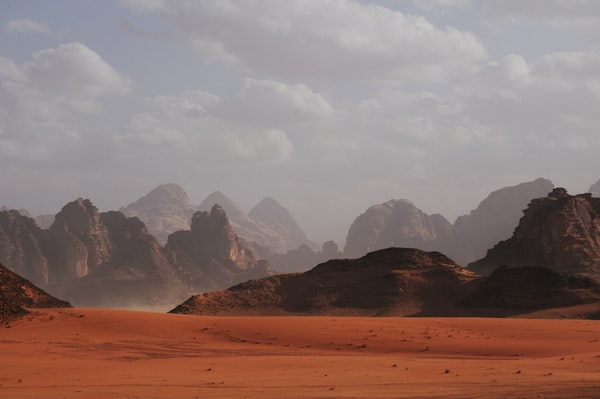
Haboob / Dust Storm
Wall of dust and sandFormation
Thunderstorm downdraft hits ground and spreads out, picking up dust. Wall can reach 1,500m high, travel 100 km/h.
Locations
- Sahara: Largest source of dust globally
- Arizona: "Haboob" from Arabic origin
- Middle East: Shamal winds carry dust
- Australia: Red dust from outback
- Caused by thunderstorm outflow
- Massive wall 500-1,500m high
- 100+ km wide front
- Advances at 50-100 km/h
- Visibility drops to zero instantly
- Lasts 10-30 minutes
- Small rotating column, fair weather
- Caused by surface heating
- 10-100m tall, 1-10m wide
- Weak winds (<70 km/h usually)
- Lasts seconds to minutes
- Harmless (rarely causes damage)
- Regional scale, multi-day event
- Caused by drought + strong winds
- Can affect entire states/countries
- Agriculture collapse
- Example: 1930s Dust Bowl (US Great Plains)
Largest Dust Source on Earth
Sahara Desert generates 1-3 billion tons of dust annually. Trade winds carry plumes across Atlantic Ocean to Americas. Dust visible from space.
Where It Goes
- Amazon Rainforest: 27 million tons/year fertilizes soil (phosphorus)
- Caribbean: Affects air quality, stunning sunsets
- Southern US: Hazy skies, "Saharan Air Layer"
- Mediterranean: "Calima" in Spain
Climate Effects
- Suppresses Atlantic hurricane formation
- Reflects sunlight, cooling effect
- Nutrients feed ocean phytoplankton
- Respiratory health impacts downwind

Nor'easter
US East Coast winter stormCharacteristics
- Northeast winds (hence "nor'easter")
- Forms along Gulf Stream boundary
- Can bring 30-60cm+ snow
- Coastal flooding from storm surge
- Peak season: Oct-Apr
Notable Storms
- 1978 Blizzard: 70cm snow, 99 deaths
- 1993 "Storm of Century": 300 deaths
- 2016 Jonas: 60cm in NYC
Miller Classification
- Miller Type A: Forms off coast, moves north
- Miller Type B: Inland low transfers energy to coastal low
- Type B often most intense - "bomb cyclones"
| Storm | Date | Snowfall | Impact |
|---|---|---|---|
| Great Blizzard of '78 | Feb 5-7, 1978 | 70 cm Boston | 99 deaths, 10,000 cars abandoned, state shut down 1 week |
| Storm of the Century | Mar 12-15, 1993 | 140 cm mountains | 300 deaths, affected 26 states, $6B damage |
| Snowmageddon | Feb 5-6, 2010 | 90 cm Washington DC | Federal gov closed 4 days, record DC snow |
| Blizzard of '96 | Jan 6-8, 1996 | 76 cm Philadelphia | 187 deaths, paralyzed East Coast |
| Jonas | Jan 22-24, 2016 | 60 cm NYC | 55 deaths, $3B damage |
| Nemo | Feb 8-9, 2013 | 102 cm CT | Power out for 350,000, travel ban MA |
Waterspout
Tornado over waterTypes
- Tornadic: Actual tornado over water, dangerous
- Fair-weather: Forms from surface up, weaker
Hotspots
Florida Keys: 400-500/year. Great Lakes in autumn. Mediterranean Sea. Usually <80 km/h but can strengthen if moving onshore.
- Forms on calm, sunny days
- Starts at water surface, builds upward
- Weak rotation (<80 km/h)
- Transparent except for spray at base
- Last 2-20 minutes
- Not from thunderstorms
- Rarely dangerous unless direct hit on boat
- Actual tornado that moved over water
- Or tornado that formed over water from severe storm
- Descends from storm cloud
- Violent winds (>150 km/h possible)
- Can move onshore and cause damage
- Associated with supercells/severe weather
- Extremely dangerous

Bomb Cyclone
Explosive cyclogenesisDefinition
Rapid intensification: pressure drops >24 mb in 24 hours. Creates hurricane-force winds in extratropical storms.
Where They Form
- Northwest Atlantic (US East Coast)
- Northwest Pacific (Japan)
- Where cold continental air meets warm ocean
Why "Bomb"?
Term from Sanders & Gyakum (1980). Meteorologically: "Explosive cyclogenesis". Criterion: Pressure fall ≥ 24 mb/24 hours (adjusted for latitude). Some drop 50+ mb in 24h.
Required Ingredients
- Baroclinicity: Strong temperature gradient (cold land/warm ocean)
- Upper divergence: Jet stream divergence aloft "sucks" air up
- Latent heat: Condensation releases energy
- Positive feedback: Falling pressure → more convergence → more rising → lower pressure
Typical Pressure Evolution
| Event | Date | Pressure Drop | Impact |
|---|---|---|---|
| Braer Storm | Jan 10, 1993 | 914 mb (record) | Strongest extratropical low ever measured |
| January 2018 | Jan 3-4, 2018 | 59 mb / 24h | US East Coast: 22 deaths, "bombogenesis" trending |
| Eunice | Feb 18, 2022 | 40 mb / 24h | UK: 196 km/h winds, 14 deaths, red warning |
| October 2021 | Oct 24, 2021 | 36 mb / 24h | California: Atmospheric river, 15+ inches rain |
| December 2022 | Dec 21-23, 2022 | 32 mb / 24h | Blizzard + Arctic blast: 50+ deaths, -45°C wind chills |
Hailstorm
Ice precipitation from thunderstormsHail Formation
Strong updrafts carry raindrops above freezing level. Ice grows in layers as stone cycles up and down. Falls when too heavy for updraft.
Size Records
- Largest: 20cm diameter (South Dakota, 2010)
- Heaviest: 1.02 kg (Bangladesh, 1986)
- Golf ball size (4.4cm) causes significant damage
Damage
$10-15 billion/year in US alone. Destroys crops, vehicles, roofs. "Hail Alley" from Texas to Nebraska most affected.
Updraft Strength Required
| Record | Location | Date | Details |
|---|---|---|---|
| Largest Diameter | Vivian, SD | Jul 23, 2010 | 20.3 cm (8 inches) - volleyball size |
| Heaviest | Bangladesh | Apr 14, 1986 | 1.02 kg - killed 92 people |
| Costliest (single event) | Munich, Germany | Jul 12, 1984 | $2B damage (70,000 buildings) |
| Deadliest Modern | Moradabad, India | Apr 30, 1888 | 246 deaths |
| Costliest US | Dallas, TX | Apr 2024 | $2+ billion in auto/property damage |
Hail Alley - Most Active Region
Wyoming-Nebraska-Colorado triangle: Most hail days per year globally. High elevation + strong jet stream + dry air = perfect conditions. Cheyenne, WY averages 9-10 hail days/year.

Monsoon
Seasonal wind reversalAsian Monsoon
- Summer (SW): Wet, Jun-Sep, from Indian Ocean
- Winter (NE): Dry, Nov-Feb, from Siberia
- 80% of India's annual rainfall in 4 months
- Feeds 1.5 billion people
Other Monsoons
- West African: Jun-Sep, brings Sahel rains
- Australian: Dec-Mar, northern Australia
- North American: Jul-Sep, Arizona/Mexico
Summer Monsoon (Wet Season)
Winter Monsoon (Dry Season)
⚠️ Impact of Monsoon Failure
Weak monsoon = drought = crop failure = famine. Over 1 billion people depend on monsoon for agriculture, drinking water, hydropower. India's GDP fluctuates 2-3% based on monsoon strength.
What Affects Monsoon Strength?
- El Niño: Weakens Indian monsoon (warm Pacific suppresses rainfall)
- La Niña: Strengthens monsoon (cool Pacific enhances convection)
- Indian Ocean Dipole: Positive = strong monsoon, Negative = weak
- Snow cover: Heavy Himalayan snow = cooler land = weaker monsoon
- Climate change: Increasing variability (stronger extremes)
Extreme Rainfall Records
- Cherrapunji, India: 26,471 mm/year (wettest place debate)
- Mawsynram, India: 11,872 mm/year average (26 km from Cherrapunji)
- 2013 Uttarakhand floods: 340 mm in 24h, 5,700 deaths
- 2005 Mumbai: 944 mm in 24h, city paralyzed
⚠️ Storm Safety Quick Guide
🌀 Hurricane Safety
- Know your evacuation zone
- Board up windows
- 3-day supply of water (1 gal/person/day)
- Fill car with gas before storm
- Evacuate if ordered
- Stay away from windows during storm
- Don't go outside in "eye" - worst is coming
🌪️ Tornado Safety
- Go to basement or interior room
- Lowest floor, away from windows
- Get under sturdy furniture
- Cover head with arms
- If in car: abandon for ditch, cover head
- Never try to outrun in a vehicle
- Mobile homes: leave for sturdy building
⚡ Lightning Safety
- 30-30 Rule: If thunder within 30 sec of flash, go inside. Stay 30 min after last thunder
- Get off elevated areas
- Stay away from isolated trees
- Get out of water immediately
- Avoid metal objects
- Car is safe (metal frame, not rubber tires)